
Application and Selection Solutions of Industrial transfer cart for the Wind Power Industry
With the continuous expansion of the global wind power industry, more and more wind turbine manufacturing plants are undergoing intelligent upgrades, resulting in increasingly higher requirements for material handling systems. Core wind turbine components, including tower sections, blades, nacelles, and main shafts, feature large weight and irregular dimensions, requiring strict standards for machining and assembly accuracy. From in-plant material transfer and cross-area transportation to finished product dispatch, these large components demand much higher load capacity, operational stability, and safety protection from handling equipment compared with conventional heavy industries.
Currently, most wind turbine manufacturing facilities still rely on traditional handling methods, such as forklifts, fixed overhead cranes, and manual assistance. While these methods are suitable for conventional workpieces, they often encounter various challenges when handling oversized wind turbine components.
Based on our years of experience in the customized manufacturing and on-site implementation of heavy-duty transfer equipment, this article combines real wind turbine manufacturing scenarios to analyze the advantages, application scenarios, selection considerations, and common issues of Industrial transfer carts, providing practical guidance for wind turbine manufacturers to upgrade their material handling systems and select suitable handling solutions.
Key Challenges in Material Handling for the Wind Power Industry
During the transfer of large wind power components, traditional handling equipment faces concentrated challenges, mainly in the following aspects:
Insufficient Heavy Load Capacity
Large wind turbine components are characterized by extremely high single-unit weights. Conventional forklifts and light-duty handling equipment have limited rated load capacities. When used for long-term transportation of overweight wind power components, they are prone to issues such as frame deformation, wheel overload, and damage to drive components. They are unable to meet the requirements of frequent and continuous heavy-duty transfer operations for large wind turbine components.
High Risk of Workpiece Damage
Wind turbine blades and nacelle housings are high-precision components with extremely strict requirements for surface coating integrity and overall structural accuracy. Traditional handling equipment often experiences noticeable impact during acceleration and braking, along with significant vibration during operation. In addition, it lacks dedicated fixing and positioning structures designed for irregularly shaped wind power components, making it prone to issues such as surface scratches, collisions, and minor deformation during the transfer process.
Poor Operational Flexibility
Fixed overhead cranes in factories can only operate within predefined track ranges, resulting in limited application scenarios. They are unable to perform flexible handling tasks such as cross-workshop transfer, outdoor yard relocation, and dockside cargo transfer.
Under heavy-duty operating conditions, forklifts have a large turning radius and poor vehicle stability. For oversized and irregularly shaped wind power components, they are difficult to precisely position and maneuver, resulting in significant operational limitations and limited adaptability to different application scenarios.
Low Overall Transfer Efficiency
Traditional handling methods for large wind power components heavily rely on manual assistance for positioning, securing, and fine adjustments, resulting in complex workflows and extended operation times.
With modern wind power production lines achieving continuous and high-frequency mass production, the transfer speed and process coordination efficiency of traditional handling equipment can no longer keep pace with production requirements, directly slowing down the overall manufacturing progress of the facility.
Multiple Safety Hazards in Operations
Large wind power components are oversized and have a high center of gravity. During manual-assisted operations, there are potential safety risks such as workpiece slipping, tipping, and crushing accidents. Meanwhile, conventional handling equipment is equipped with relatively basic safety features and lacks multi-level protection and warning systems. When operating in complex wind turbine manufacturing environments, the overall safety risk remains high.
Basic Definition of Industrial Electric Transfer Carts
Electric transfer carts, also known as industrial transfer carts or heavy-duty transfer carts, are heavy-load handling equipment specifically designed for industrial facilities. The equipment is fully electrically driven and equipped with a variable frequency control system, independent travel drive structure, and high-strength load-bearing frame, ensuring a robust and durable overall structure.
This equipment is mainly designed for short-distance heavy-load transportation within industrial plants. It features stable operation, strong load capacity, and high safety performance, specifically addressing heavy-duty handling applications that conventional forklifts and small transport vehicles cannot handle. It is now widely used in wind power and renewable energy, heavy machinery, metallurgy, large-scale equipment manufacturing, and other industries.
Compared with conventional forklifts and light-duty handling equipment, the biggest advantage of Industrial transfer carts is their ability to safely and smoothly transport heavy, irregularly shaped, and high-precision workpieces with minimal impact or damage during operation. The equipment also supports customized solutions, with power supply methods, travel modes, platform dimensions, and supporting fixtures adjustable according to customers’ specific operating conditions.
With advantages including sufficient load capacity, stable operation, low failure rate, and wide application adaptability, Industrial transfer carts have become the mainstream equipment for replacing traditional material handling solutions in the wind power industry.
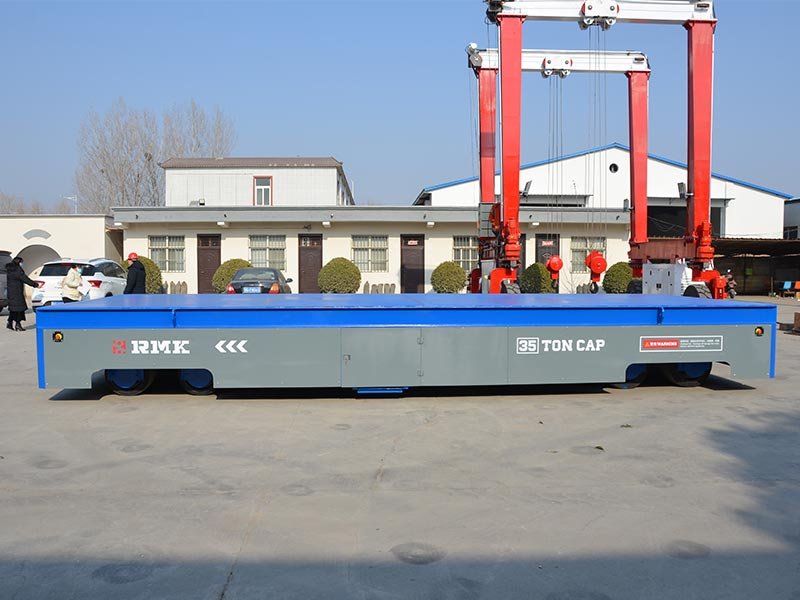
Key Features and Advantages of Industrial Transfer Carts for the Wind Power Industry
Designed for the special operating conditions of oversized, heavy-duty, irregularly shaped, and high-precision wind power components, we have developed dedicated Industrial transfer carts for the wind power industry through targeted optimization and engineering improvements. Compared with standard transfer carts, these specialized units are fully adapted to wind power manufacturing requirements, effectively addressing the challenges of traditional handling methods. The key advantages include:
01——
Strong Load-Bearing Capacity
The equipment adopts an integrated box girder welded structure, providing high frame rigidity and excellent deformation resistance. Load capacities from 10t to 500t can be customized according to specific requirements, covering the majority of heavy-duty wind power component transfer applications. The transfer cart platform can be extended and widened through customization, easily accommodating oversized and irregular components such as extra-long wind turbine blades and non-standard tower sections.
02——
High Operational Stability
The equipment is equipped with variable frequency speed control as standard, supporting soft start and stop functions to eliminate impact forces during acceleration and braking. This prevents workpiece collisions and positional deviations. Shock-absorbing components reduce vibration from uneven ground, protecting high-precision components such as wind turbine blades and nacelles. Both track-mounted and trackless models provide precise maneuverability for smooth, deviation-free transfer.
03——
Multiple Safety Protection Systems
The machine is equipped with multiple safety features, including audible and visual alarms, infrared obstacle detection, emergency power-off, and travel limit switches. Combined with overload, leakage, and power-off self-locking protection, the equipment automatically stops under abnormal conditions. Wind power-specific positioning limit devices and anti-slip support fixtures can be added to prevent movement or tipping of irregular components, reducing operational risks.
04——
Wide Application Adaptability
The equipment supports multiple power supply options, including battery power, low-voltage rail power supply, and cable reel power, meeting short-distance and long-distance transfer requirements. It is available with track-mounted or trackless polyurethane wheel travel systems, adapting to fixed production lines, outdoor storage yards, and cross-workshop transfer applications. The intelligent control system can be upgraded to meet the requirements of smart wind power factories.
05——
Low Maintenance Cost
The equipment features a robust and simple structure, fewer wearing parts, and a low failure rate, enabling 24/7 high-frequency continuous operation in industrial facilities. Trackless models require no infrastructure construction for rail installation and can be put into operation immediately after delivery, significantly reducing modification costs.
By replacing multiple traditional handling devices and manual labor, it effectively reduces maintenance costs, labor expenses, and workpiece damage costs, delivering excellent long-term cost performance.
Key Application Scenarios of Industrial Transfer Carts in the Wind Power Industry
Based on years of experience in wind power project implementation, Industrial transfer carts can comprehensively cover the entire process of wind power component manufacturing, assembly, in-plant transfer, finished product dispatch, and dockside handling. Customized solutions can be matched according to different operating conditions.
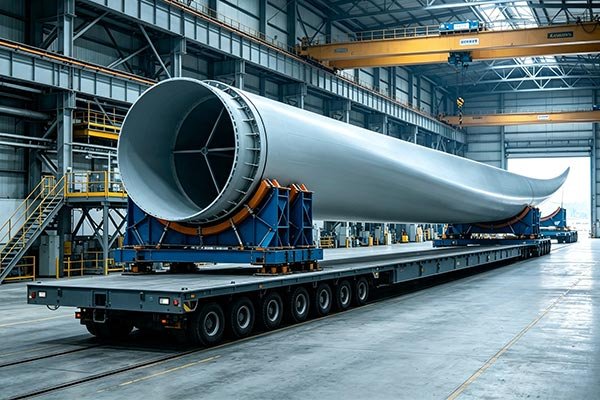
Wind Turbine Blade Production Transfer
Wind turbine blades are long, flexible structures with highly vulnerable surface coatings that are prone to scratches and deformation, making them unsuitable for traditional rigid handling methods. The industry widely adopts trackless Industrial transfer carts equipped with flexible support fixtures, enabling low-speed and stable operation without rigid contact or friction. These carts can flexibly move between different workstations to complete the entire transfer process, including blade demolding, grinding, coating, and finished blade storage operations.
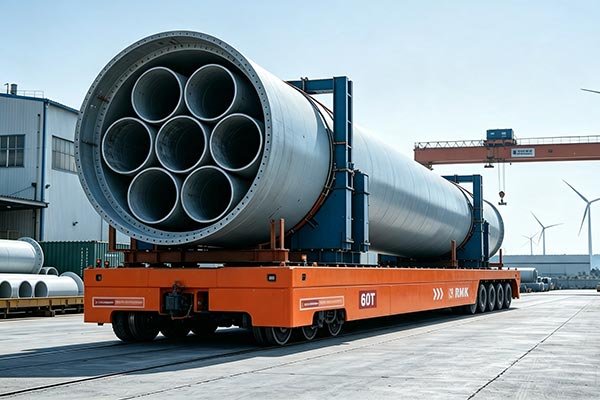
Wind Turbine Tower Sections / Monopile Transfer
Wind turbine tower sections and monopiles feature hollow cylindrical structures with concentrated heavy loads and high risk of rolling or sliding, requiring high transfer stability. Heavy-duty track-mounted Industrial transfer carts are used, equipped with dedicated arc-shaped positioning fixtures. Through multi-point load distribution structures, pressure is evenly dispersed, ensuring precise positioning and stable operation. The equipment is suitable for tower section segmentation, in-plant transfer, finished product stacking, and conditions.
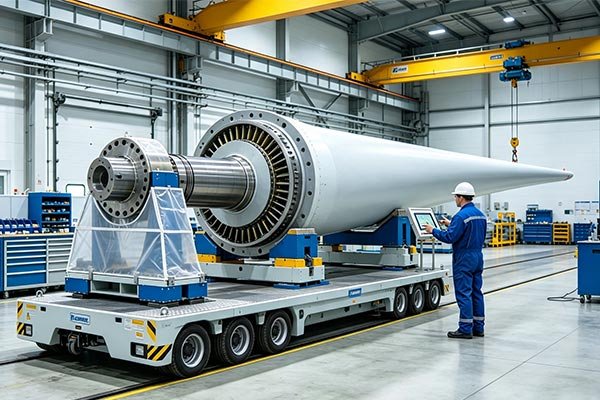
Nacelle & Main Shaft Component Transfer
Nacelles and main shafts are high-value, precision wind turbine components, featuring complex structures and strict requirements against impact and vibration. Dedicated variable frequency vibration-damping Industrial transfer carts provide smooth acceleration and deceleration with low vibration throughout transfer. Equipped with emergency stop systems, they enable damage-free transportation of precision components while ensuring machining accuracy and product appearance integrity.
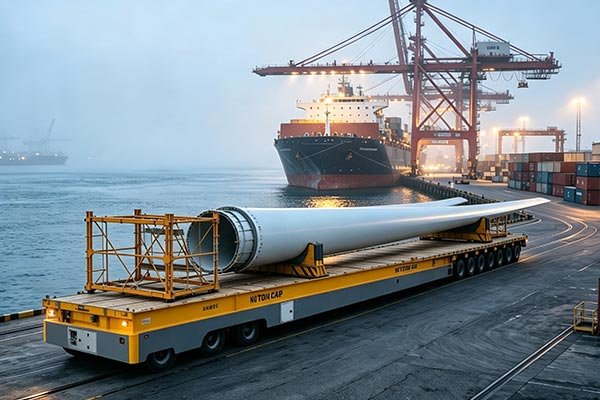
Finished Product Dispatch and Dockside Transfer
For long-distance and complex ground condition transfer scenarios from workshops to storage yards and storage yards to docks, long-endurance battery-powered Industrial transfer carts are preferred. With no rail limitations, stable endurance, and strong environmental adaptability, the equipment supports all-weather high-frequency operations. It is suitable for large-scale applications such as finished product dispatch, loading, and dockside transfer, improving overall shipment and transfer efficiency.
Professional Selection Guide for Wind Power Transfer Carts
During equipment selection, many customers often encounter issues such as mismatched operating conditions, excessive load capacity redundancy, and equipment underutilization. Based on years of practical on-site experience, we have developed a simple, accurate, and wind power-oriented transfer cart selection guide to help quickly match the right equipment for specific applications.
Selection Based on Operation Route
For fixed production lines and point-to-point reciprocating operations within workshops, low-voltage rail transfer carts and cable reel rail transfer carts are preferred. For applications without fixed operating routes that require flexible transfer across multiple areas of storage yards, battery-powered trackless transfer carts are the ideal choice, offering stronger adaptability.
Selection Based on Load Capacity
For lightweight components under 10 tons, standard transfer carts are sufficient to meet operational requirements. For conventional heavy components such as tower sections and main shafts ranging from 10t to 100t, heavy-duty standard transfer carts are recommended. For complete nacelles above 100 tons and oversized irregular components, customized reinforced multi-wheel load-sharing transfer carts are required to prevent overload deformation and ensure operational safety.
Selection Based on Transfer Distance
For short-distance, fixed-point transfers within workshops, cable reel-powered and low-voltage rail-powered transfer carts are suitable options. For long-distance transfer applications such as cross-workshop transportation, outdoor storage yards, and dockside operations, battery-powered Industrial transfer carts are preferred, eliminating power line restrictions and providing greater operational flexibility.
Selection Based on Intelligent Requirements
For conventional wind power production lines, manually controlled transfer carts are sufficient to meet production requirements. For unmanned smart factories, AGV automatic guided transfer carts can be upgraded to achieve automatic navigation, precise positioning and stopping, and fully unmanned material transfer operations.
Selection Based on Operating Environment
For dust-free indoor production workshops, conventional standard protection models are sufficient to meet operational requirements. For complex working environments such as outdoor storage yards, humid areas, and high-dust conditions, it is recommended to select elevated models with enhanced waterproof and dustproof protection, effectively improving equipment stability and service life.
Conclusion
For the special transfer challenges of the wind power industry, including heavy loads, irregular shapes, high precision requirements, and strict safety standards, customized Industrial transfer carts can effectively overcome the limitations of traditional forklifts, overhead cranes, and manual handling methods. With advantages of high load capacity, excellent stability, enhanced safety, and strong adaptability, they not only reduce the damage rate of wind power components during transfer but also significantly improve in-plant transportation efficiency, helping enterprises reduce costs, increase productivity, and achieve standardized production.
With years of expertise in the R&D and manufacturing of heavy-duty transfer carts, our company specializes in material handling solutions for the wind power industry. Based on customers’ specific operating conditions and component parameters, we provide one-to-one customized transfer solutions to meet the production and transportation requirements of all types of wind power components.
FAQ
References & Sources
1. Wind Power Industry Growth-Global Wind Energy Council (GWEC)
2. Large Wind Turbine Development Trends-International Energy Agency (IEA)
3. Forklift Safety Requirements-Occupational Safety and Health Administration (OSHA)